

















Cloud MES is a Manufacturing Execution System that runs on remote infrastructure instead of on-premises servers. It lets teams access production data remotely, add capacity without buying new hardware, and use modern analytics while still running day-to-day execution work on the shop floor.
Manufacturing Execution System (MES) software manages, monitors, and improves production operations. It coordinates workflows, captures execution data, and enforces process rules at the line and work-cell level. The functions of an MES are defined by the ISA-95 standard (also known as IEC 62264), which establishes a common framework for integrating enterprise systems with manufacturing operations and control. Cloud MES changes the delivery model from on-premises servers to cloud services. The purpose stays the same: control and improve manufacturing execution.
Cloud MES runs on cloud infrastructure (public, private, or hybrid) and can scale without new hardware. That matters when a site needs more users, more storage, or faster reporting. It also connects more cleanly with cloud tools like IoT platforms, analytics dashboards, and ERP systems. Compared with an on-premises deployment, Cloud MES removes the need to provision and maintain site-level servers just to expand.
Understanding cloud MES and how it differs from traditional systems
Who runs the platform matters. Cloud MES differs from traditional on-premises MES mainly because cloud services take on deployment, updates, and operational support. Execution still stays centered on the shop floor.
For many manufacturers, the appeal is workload. The provider typically handles updates, maintenance, and security tasks that internal IT teams would otherwise own. You can start small with one line, one site, or one product family and expand as requirements grow, instead of sizing hardware for a future state on day one. Access is often steadier for distributed stakeholders, which helps teams coordinate across multiple sites and production stages using real-time data on demand.
In practice, the MES work stays on the shop floor. The difference is who runs the platform behind it.
A hosted deployment means the MES runs on provider-managed infrastructure instead of on-premises servers. In many cases, it runs on a virtual machine. Integrations are exposed through an application programming interface (API), which moves events and records between systems.
Cloud MES commonly runs in a public cloud such as Amazon Web Services. It can also follow a Software as a Service (SaaS) model, where the vendor operates the application end to end, including updates and day-to-day operations.
Cloud-native MES is not the same as cloud-based MES. Cloud-native MES is built from the start for cloud technologies and is based on microservices, which are smaller services deployed independently. That structure supports modular rollouts and targeted deployment. It can also let manufacturers pay for the functionality they actually need.
One industry source reports cloud-based MES can reduce total cost of ownership by 30–40% versus an on-premises alternative (Source: Shoplogix, "Total Cost of Ownership for MES," 2025).
The following table compares common MES deployment approaches and what distinguishes each one.
|
MES approach |
How it is built |
Typical runtime model |
What drives the difference |
|---|---|---|---|
|
Cloud-based MES |
MES delivered using cloud services |
Vendor-managed or customer-managed in cloud |
Delivery model centers on cloud rather than local infrastructure |
|
Cloud-native MES |
Designed for cloud from the start; based on microservices |
Modular services deployed independently |
Targeted deployment supports paying for needed functionality |
|
Cloud-hosted (lift-and-shift) |
Existing MES moved to hosted deployment |
Often runs as a VM on provider infrastructure |
Infrastructure changes, but application design may stay largely unchanged |
The real decision often comes down to: a single platform footprint, or modular services you can evolve independently? LNS Research identifies four distinct categories of manufacturing execution solutions, reflecting how the MES market has fragmented beyond the traditional single-vendor model.
What is cloud-based MES?
Cloud-based MES brings real-time monitoring and control of manufacturing operations to a cloud environment. It relies on remote servers. Authorized users can access live production data and analytics from anywhere with an internet connection.
This access model supports coordination across multiple sites and production stages. Execution data stays available on demand rather than locked inside a single plant network.
Cloud-based MES may be delivered as SaaS or operated by a manufacturer on cloud infrastructure. It commonly connects to other systems through APIs, keeping production status, quality results, and material movements consistent across teams and sites.
Key functions of cloud MES on the modern shop floor
What do you actually get on the floor? Cloud MES typically brings real-time production monitoring, quality management, analytics, ERP integration, and cloud data storage into one operating model. This works even when teams operate across multiple plants.
Real-time production monitoring tracks metrics like output, downtime, and cycle time while work is still in progress. Supervisors can react to constraints before the shift ends. Cloud-based MES stores and updates production data, procedures, work orders, and quality records in the cloud, then delivers them to authorized devices when they are needed.
Digitization usually follows once teams agree on how operators will record production events. The small details matter: timestamps, reasons, and who entered what.
Quality management covers the controls that keep products within spec: inspection, defect tracking, and compliance reporting. In Cloud MES, quality often runs as connected workflows including defect tracking, root cause analysis, and statistical process control tied to work orders, equipment states, and operator actions.
Advanced analytics and reporting turns manufacturing data into dashboards, trends, and decision support. Cloud MES can generate reports that surface performance patterns, flag maintenance needs, and support reviews of operational efficiency. Maintenance teams use those signals to decide what to fix first, acting before a failure forces the issue.
On the floor, it often shows up as one simple change: fewer blind spots during the shift.
Cloud MES software integrates with enterprise tools such as ERP systems so production and business data stay aligned. When integration works well, it reduces data silos and improves end-to-end visibility from planning through execution.
Several manufacturers have reported measurable results after moving to cloud MES. These are vendor-reported figures and should be evaluated accordingly:
|
Operational result |
Metric |
Context |
|---|---|---|
|
Lower downtime |
10% decrease within 6 months |
Meleghy Automotive (SYMESTIC deployment) |
|
Lower downtime |
5% reduction |
Brita (SYMESTIC deployment) |
|
Higher output |
7% increase |
Brita (SYMESTIC deployment) |
How cloud MES is architected: SaaS, edge, and integrations
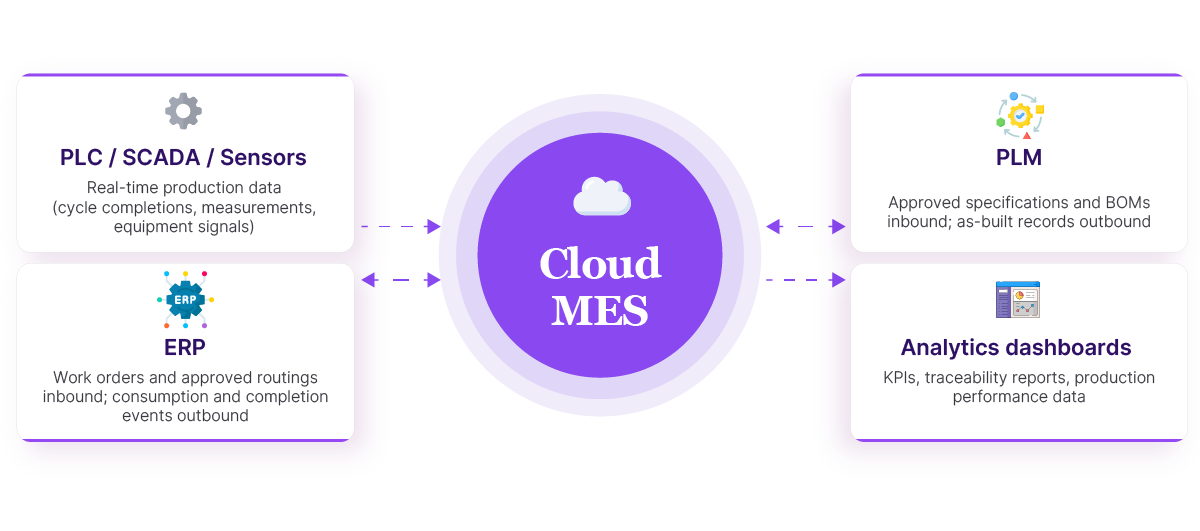
Most Cloud MES setups combine three pieces: SaaS delivery in a cloud environment, an optional site-level runtime (often VM-based) for plant needs, and API-driven integration that connects enterprise systems with shop-floor systems.
Software as a Service (SaaS) means the application runs in a public cloud and users sign in through a browser or app with no local install on every machine. That subscription model shifts spending from capital expenditures to operating expenditures, which changes how many teams budget MES work.
The architecture question is often less about "cloud or not" and more about where each workload runs and how data moves safely between systems.
Public cloud MES is hosted on shared servers managed by a third-party provider and is often positioned for small to medium-sized manufacturers that want to reduce IT infrastructure costs. Private cloud MES is dedicated to a single organization and often positioned for regulated environments such as medical device manufacturing or aerospace. Hybrid cloud MES mixes both models, keeping sensitive data in a private cloud while using public cloud resources for less-critical processes.
The following table compares deployment options by budget, production scale, and compliance fit:
|
Deployment option |
Budget fit |
Production scale fit |
Data security / compliance fit |
|---|---|---|---|
|
Public cloud MES |
Lower infrastructure spend |
Single-site to multi-site growth |
Shared infrastructure; validate tenant isolation controls |
|
Private cloud MES |
Higher baseline run cost |
Regulated, stable environments |
Dedicated to one organization; aligns to strict compliance needs |
|
Hybrid cloud MES |
Balanced run cost |
Mixed criticality workloads |
Sensitive data stays private; public resources for less-critical processes |
|
Multi-tenant cloud MES |
Shared infrastructure efficiencies |
Many smaller orgs or divisions |
Requires strong data segregation guarantees |
|
Industry-specific cloud MES |
Can reduce configuration effort |
Plants with sector-standard workflows |
Pre-configured workflows aligned to sector standards |
APIs tie Cloud MES to enterprise and shop-floor software so workflows and data move end to end. MES integrates with shop-floor systems such as PLCs, SCADA systems, and historians, and with enterprise systems such as ERP and PLM.
On the integration side, APIs typically handle three types of handoffs:
- Automatic measurement capture: APIs ingest gauge or test-station results so Cloud MES links measurements to a serial, lot, and operation step.
- Step transitions: APIs advance a unit from one operation to the next when a PLC or SCADA signal confirms a completed cycle.
- Traceability handoffs: APIs push consumption and completion events to ERP and pull approved routings or specifications from PLM.
How fast you go live depends on what you pick. The following timelines are self-reported by vendors and describe different scopes:
|
Approach |
Time to initial value |
Scope described |
|---|---|---|
|
Cloud MES (On Time Edge) |
1–3 months |
Full implementation |
|
Traditional MES (On Time Edge) |
6–12+ months |
Full implementation |
|
Cloud-native MES (SYMESTIC) |
Days to weeks |
Initial connectivity |
|
Cloud-native platforms (SYMESTIC) |
Under 6 months |
Complete MES deployment |
When evaluating, ask each vendor the same question: "What's included in that timeline, and what's not?" The answer separates real benchmarks from marketing claims.
When evaluating specific Cloud MES solutions, verify these architecture-related factors:
|
Cloud MES solution |
What to verify during evaluation |
|---|---|
|
Manufacturo |
Cloud-native architecture; implementation speed (vendor states go-live in as little as one week for initial scope); update cadence; operator onboarding time; API surface for ERP/PLM/shop-floor connectivity |
|
Plex |
Deployment options offered; API surface; ERP/PLM and shop-floor connectivity coverage |
|
Siemens Opcenter |
Integration model across ERP/PLM and PLC/SCADA/historians; hosting and tenant model |
|
AVEVA |
Data model for real-time and history; integration approach for existing OT/IT systems |
|
Tulip |
Speed to initial KPIs; device access model; API-based integration approach |
|
Infor CloudSuite Industrial |
ERP-to-execution integration depth; identity and role management; deployment model |
When manufacturers benefit most: typical cloud MES use cases
Fast visibility is the usual trigger. Cloud MES tends to pay off when teams need secure, cross-site visibility and control at a scale that would otherwise require significant shop-floor IT infrastructure.
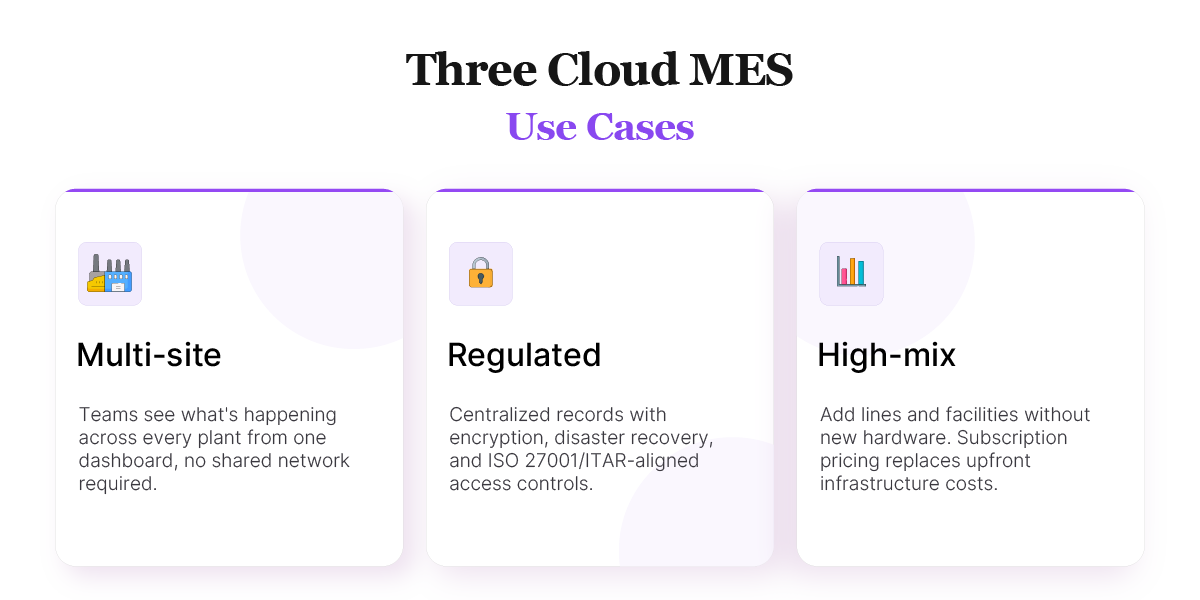
Cloud connectivity puts functions like inventory monitoring on mobile devices across locations. Some deployments give real-time access to data from large equipment fleets from a single device. For many teams, the use case is simply not having to be on the same network, or even in the same plant, to see what is happening.
Data security often becomes a primary driver when records must be centralized without weakening controls. Cloud MES can support secure data storage with encryption, compliance measures, regular updates, and disaster recovery protocols on remote servers. ISO 27001 and ITAR commonly shape role design and data-handling rules for Cloud MES deployments.
Scaling gets easier when Cloud MES connects additional lines and spreads across facilities as operations change. Subscription-based pricing reduces upfront hardware, installation, and maintenance costs compared to on-premises systems.
Yanfeng International, a global automotive supplier with over 30 sites and 500+ connected segments, reported that KPI reporting time dropped by over 90% after adopting Cloud MES capabilities (SYMESTIC deployment, vendor-reported).
The pattern across these use cases is the same: teams that outgrow spreadsheets but aren't ready to staff a full IT infrastructure project find cloud MES meets them where they are.
|
Industry |
Typical Cloud MES use case focus |
Primary decision driver |
|---|---|---|
|
Medical devices |
Electronic device history records and audit-ready reporting |
Strict compliance expectations |
|
Automotive |
Cross-plant visibility, standardized work instructions, and traceability |
Consistency across global operations |
|
Aerospace/defense |
Role-based access and controlled technical data handling |
ITAR-driven data security constraints |
|
Semiconductors |
High-volume equipment connectivity and rapid exception handling |
Large asset fleets and tight process windows |
|
Food and beverage |
Lot traceability, quality holds, and fast reporting |
Recall readiness and speed |
|
Pharmaceuticals |
Automated documentation and review support |
Audit support and controlled records |
|
Consumer electronics |
Rapid line additions and fast KPI visibility |
Frequent product changes |
Adoption does come with tradeoffs. The following table is one of the more useful references in this article because it treats the reader as someone who knows nothing is free:
|
Adoption tradeoff |
Risk |
Mitigation pattern |
|---|---|---|
|
Internet dependence |
Visibility gaps during connectivity loss |
Define network reliability requirements per area and set local procedures for critical steps |
|
Downtime impact |
Execution disruption if a service is unavailable |
Use disaster recovery protocols and operational fallbacks aligned to criticality |
|
Security and compliance |
Unauthorized access or policy violations |
Apply encryption, role-based access, and security controls aligned to ISO 27001 and ITAR needs |
|
Workforce adoption |
Inconsistent data capture and weak process adherence |
Run change management with training, clear ownership, and staged rollout by value stream |
Benefits and limitations of cloud MES versus on-premises solutions
Cloud MES versus on-premises MES is a trade. You give up some local infrastructure control in exchange for easier scaling, broader access, and provider-run updates. You also take on more dependence on connectivity and need the organization ready to adopt new ways of working.
Accessibility is often the first benefit teams notice. They can reach production data across facilities and geographic locations. Collaboration improves when everyone works from the same dashboards and current execution data, helping stakeholders coordinate across MES, ERP, and supply chain workflows.
Many Cloud MES platforms run on a subscription model that includes regular updates and ongoing support. This reduces the need for servers, data centers, and some IT staffing tied to traditional systems. Capacity can be adjusted without major infrastructure changes, though service limits still need to be managed.
Some platforms include no-code or low-code tools so engineers and operators can adjust workflows or build forms without waiting on a developer.
The upside is speed and reach. The tradeoff is that reliability becomes a shared responsibility across operations, IT, and the provider.
Cloud MES can integrate with systems such as ERP, APS, and the Industrial Internet of Things (IIoT) to provide a unified view of operations. It can also support regulatory compliance by monitoring, storing, and analyzing the data needed for multi-plant traceability and compliance records on one platform.
Some deployments support electronic device history records (eDHR) and export-controlled data handling requirements. In these areas, permissions, audit trails, and retention rules have to be tight.
Change management often decides whether operators capture consistent data and follow digital workflows. Major cloud service providers such as Microsoft and Amazon are described as providing security levels often higher than most manufacturers could achieve on their own.
Cloud service providers may guarantee 99.9% uptime, which translates to roughly 8.7 hours of downtime per year. Cloud MES vendor SLAs may differ; some guarantee 99% uptime, which allows for roughly 87 hours per year. On-premises MES implementation can take 12–24 months (Sources: Google Cloud Compute Engine SLA, 2025).
Key security controls for Cloud MES deployments include:
- Encryption: Protect data at rest and in transit for production records and quality history.
- MFA and role-based access: Restrict access to authorized users across plants and partners.
- Zero-trust segmentation: Minimize implicit trust between user devices, APIs, and workloads.
- Audit logs: Record who changed workflows, work orders, or quality dispositions and when.
- Disaster recovery: Define recovery objectives and test restoration for execution-critical services.
|
Decision area |
Cloud MES advantage |
Cloud MES limitation |
On-premises advantage |
|---|---|---|---|
|
Access and collaboration |
Remote access to production data across locations |
Depends on stable internet connectivity |
|
|
Updates and support |
Subscription includes updates and ongoing support |
Release cadence requires validation and training coordination |
Change timing stays fully under internal control |
|
Scale |
Scale up/down without new infrastructure |
Capacity planning shifts to subscription and service limits |
Hardware sizing can be customized for site-specific constraints |
|
Integration breadth |
Connect ERP, APS, and IIoT for a unified view |
Integration governance becomes a cross-team responsibility |
Deep customization easier when systems are co-located |
|
Compliance |
Monitor and analyze data for multi-plant compliance on one platform |
Policies must cover external access, retention, and audit needs |
Data residency simpler when systems stay in one facility |
|
Cost structure |
Shift spending away from servers, data centers, and some IT staffing |
Ongoing subscription spend must match realized value |
Capital investment suits stable, long-lived installations |
Cloud MES works well for access, scaling, and operational support. It holds up with disciplined security controls, clear connectivity expectations, and change management that sticks on the line.
Planning areas for Cloud MES deployment
Before selecting a deployment model, manufacturers typically work through several planning areas. These are included here rather than in the introductory section, because they're most useful after a team has decided to pursue cloud MES and needs to plan the rollout.
- Operational needs assessment: Select a first scope (line, site, or product family) and define the highest-value execution decisions Cloud MES must support.
- Integration planning (ERP/equipment/IoT): Map required data flows, define API ownership, and identify which systems publish versus consume shop-floor events.
- Data security and compliance: Define identity and access roles, retention rules, and audit expectations before enabling broader stakeholder access.
- Change management: Assign process owners for electronic work instructions, exception handling, and training tied to rollout waves.
- Network reliability: Document connectivity expectations for each work area and define fallback procedures for critical operations.