
















AI in Manufacturo. So Engineers Can Engineer.
Magenta AI agents handle the busy work that slows down production.

Engineers are most valuable in high-complexity manufacturing when they're solving production challenges, making critical design decisions, and driving throughput improvements. Not chasing paperwork.
We're guessing that your engineers don't enjoy coordinating verifications and cross-referencing information any more than management wants them performing low-level work like:
Here's where AI agents shine, acting as dedicated, detail-oriented assistants. They pull data from within Manufacturo and act on it, so your engineers don't have to.
Depth and breadth of Manufacturo data combined with Magenta AI expertise
AI in manufacturing is only as good as the data feeding it. Manufacturo's rigorous data capture covers every production event - work orders, procedures, nonconformances, inspections, component movements, quality events - and is classified, traceable, and linked from the moment it's created.
Years of detail-rich production history are organized in a structured, queryable format that AI agents can work from directly, enabling them to quickly surface patterns and act on them - for example, identifying disposition paths that worked for similar defects across thousands of past NCs.
Manufacturo has partnered with Magenta, an AI platform purpose-built for complex manufacturing, to boost efficiency for their customers.
The result? Reliable data in, quality recommendations out.
Making Your Team More Efficient and Accurate
Our AI agents handle tasks that require routine judgment and follow repeatable patterns. There are many use cases, but here are four practical examples.
How to generate a process plan with AI?
AI drafts work instructions from engineering documents, specs, prior procedures, or new data being entered - applying the same guidelines used in procedure review so the output is already aligned with your standards. Also covers unplanned rework instructions that NC dispositions demand on short notice, when the floor is blocked.
Today
Manufacturing engineers spend hours on data entry and document import to build a process plan; senior talent is doing time-consuming, manual work.
With AI
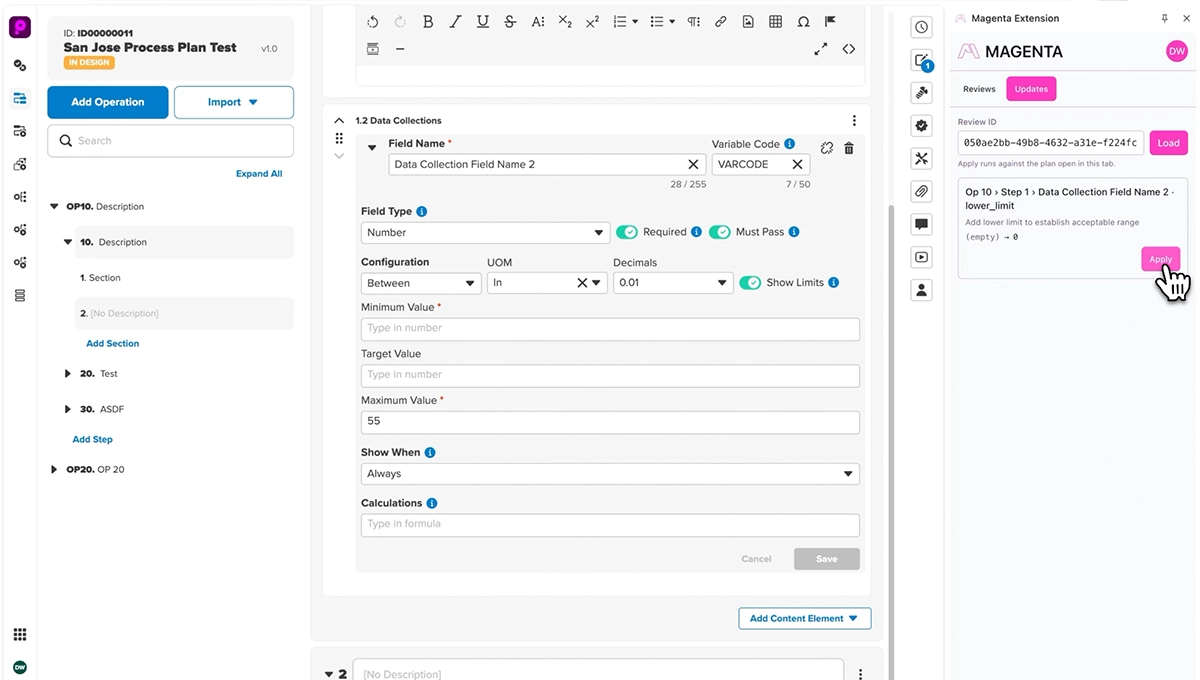
AI automates the creation of structured process plans that contain sequence of operations, work instructions, data collections, and more. Engineers review, amend and approve rather than author from scratch.
How can AI help you with reviewing process plans?
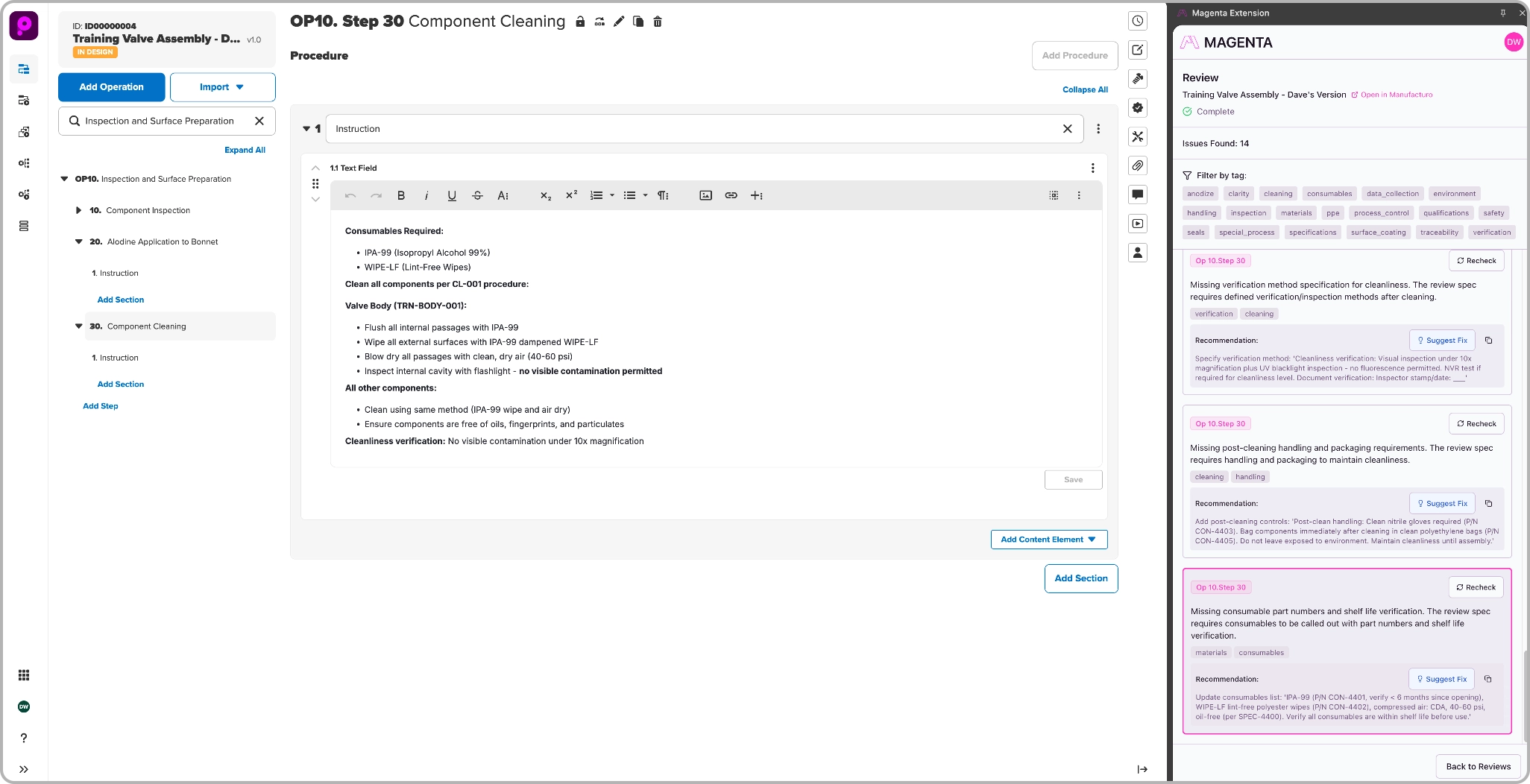
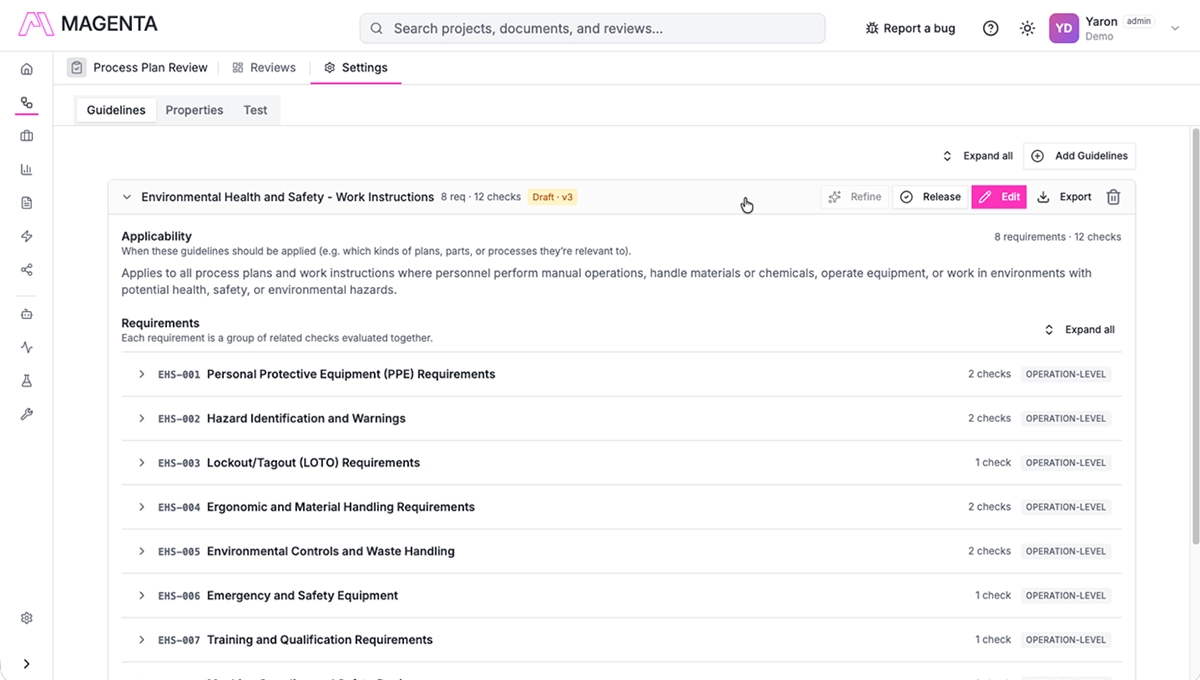
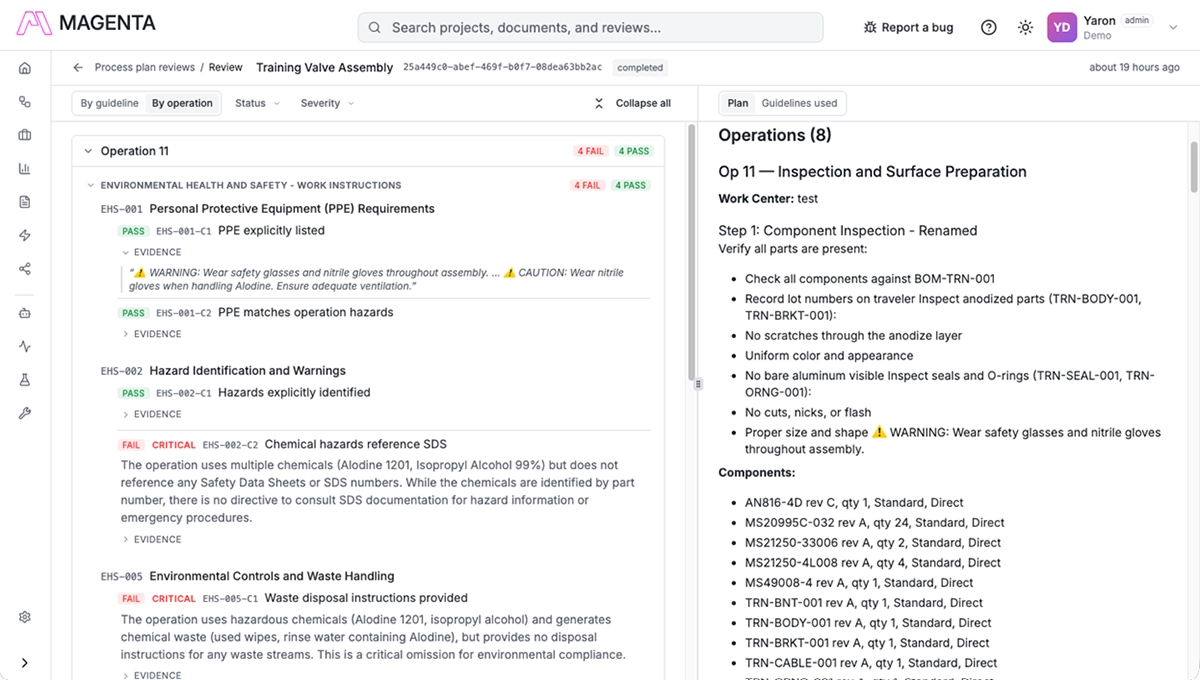
AI auto-selects the applicable guideline set based on plan type, checks alignment across steps, compares against prior versions to generate a change-log summary, and surfaces findings with apply-fix suggestions. Also supports small-team audit use cases - for example, a single EHS reviewer auditing all work instructions for high-pressure systems.
Today
Procedures go through sequential human review, where EHS, quality, and verification issues slip through because no single reviewer catches everything. Basic problem are found by high rank engineers, rather than the process author at the first place.
With AI
Each procedure is automatically checked against your organization's standards, scoped to the plan type (fabrication, assembly, inspection, outside processing). Every angle is covered in a single pass. Problems surface before production, not during.
How to take care of nonconformance generation with AI?
When a technician or inspector spots a defect, an AI agent captures the issue through voice or structured input. It asks follow-up questions driven by your organization's guidelines (for example, on "scratch" it prompts for depth and width), validates that descriptions match classifications, and searches your NC history to surface related past tickets. Engineers can act on the NC immediately.
Today
Technicians submit incomplete NC tickets with missing details, conflicting data, or misclassified root causes. Disposition engineers waste time chasing information before they can even start.
With AI
An AI agent walks the technician through structured intake - validating descriptions against classifications, asking guideline-driven follow-up questions, surfacing similar past NCs, and flagging conditions with standard repairs. Tickets come out complete the first time.
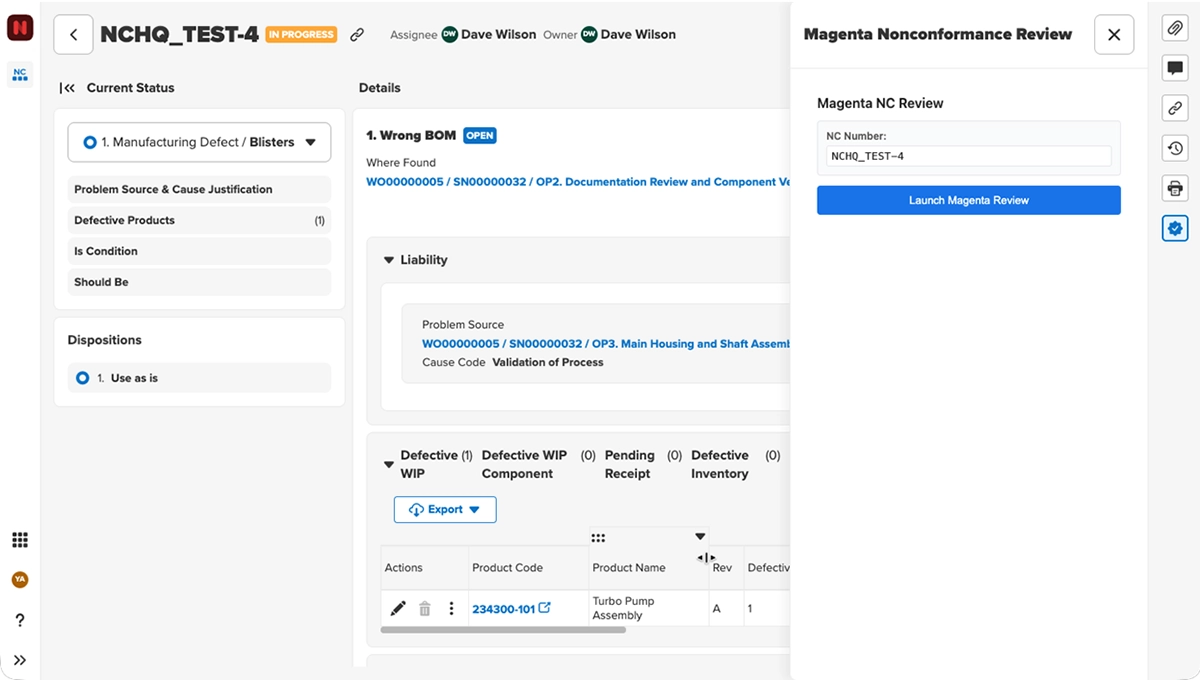
How to use AI for nonconformance review and dispositioning?
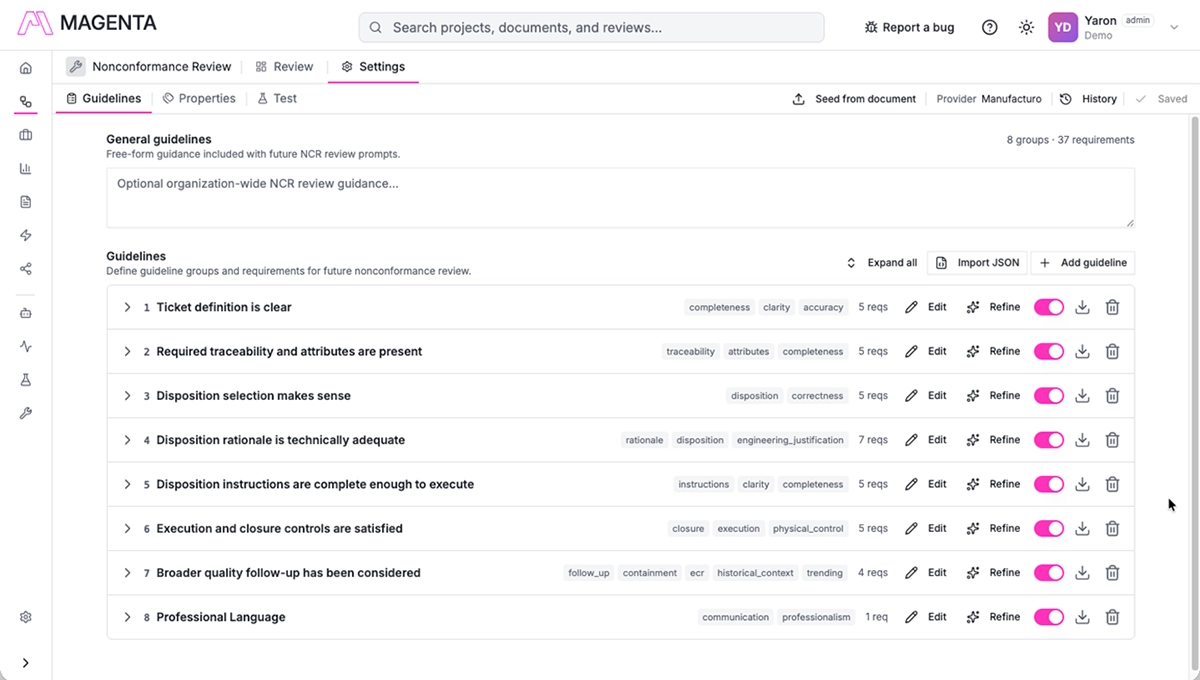
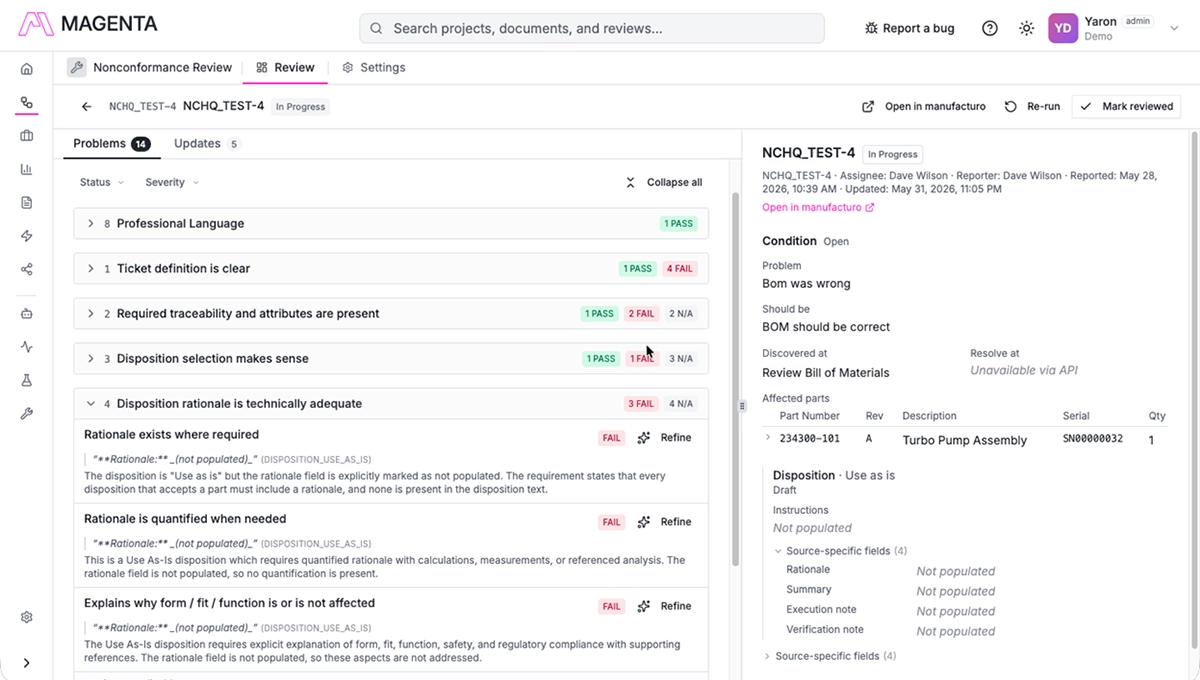
Engineers see the same types of problems again and again. AI recognizes those patterns, validates reject-code categorization, detects shared root causes that should trigger a CAPA, and recommends a disposition citing the specific data that supports it. Runs on demand or as scheduled batches.
Today
Engineers spend days cross-referencing specs, drawings, and past NCs to determine how to disposition a nonconformance. Review meetings stack up.
With AI
AI analyzes the NC against specs, drawings, and process requirements, surfaces how similar defects were handled before, and recommends a disposition - use-as-is, rework, scrap, or return-to-vendor - backed by data. Days collapse into minutes.
Purpose-built for regulated manufacturing
Manufacturo and Magenta AI capabilities meet the stringent compliance requirements of aerospace, defense, space, and advanced energy manufacturing programs. All actions and data outputs are traceable, versioned, and audit ready.

ITAR
Export compliance - US defense programs

FedRAMP
Federal cloud security standards (in progress)

SOC2
Security, availability, and confidentiality controls
Common questions
If your question isn't covered here, our team can walk you through the specifics.
Manufacturo integrates Magenta AI to extend what your team can do inside the production environment - starting with Nonconformance and Process Plan workflows, with more on the way.
An AI agent captures defects through structured input, validates the data, asks guideline-driven follow-up questions, and pulls in relevant history - so every NC record arrives structured and ready for dispositioning.
AI analyzes the NC against specs, drawings, and process requirements, surfaces how similar defects were handled before, and recommends a disposition citing the data that supports it - giving your team a defensible starting point, not a blank page.
AI builds process plans from your existing data and documents, applying the same organizational guidelines used in procedure review. Engineers review and approve rather than author from scratch.
Manufacturo and Magenta AI meet the regulatory requirements of the industries and regions we serve, including ITAR, FedRAMP, SOC2, and NIS2. What's more, all AI outputs are traceable, versioned, and audit ready.
The quality of AI outputs depends on the data supporting them. Manufacturo captures the production record end-to-end: every work order, procedure, nonconformance, inspection, and quality event is structured, linked, and traceable from the moment it enters the system. Such a context gives AI a complete picture of your operation, not a partial snapshot. Magenta AI brings the intelligence, Manufacturo brings the data – the combination is what makes the outputs actually useful.

See how AI works inside Manufacturo - from nonconformance intake and disposition to procedure review and generation.